

Infertility treatment can sometimes be quite complicated and time-consuming, especially when pregnancy does not occur despite the best efforts of the patient and doctors. Cases with poor quality oocytes and embryos are considered particularly difficult to overcome. In addition, neither doctors nor patients can identify and prevent a number of problems that may arise during treatment in advance.
What is nuclear transfer?
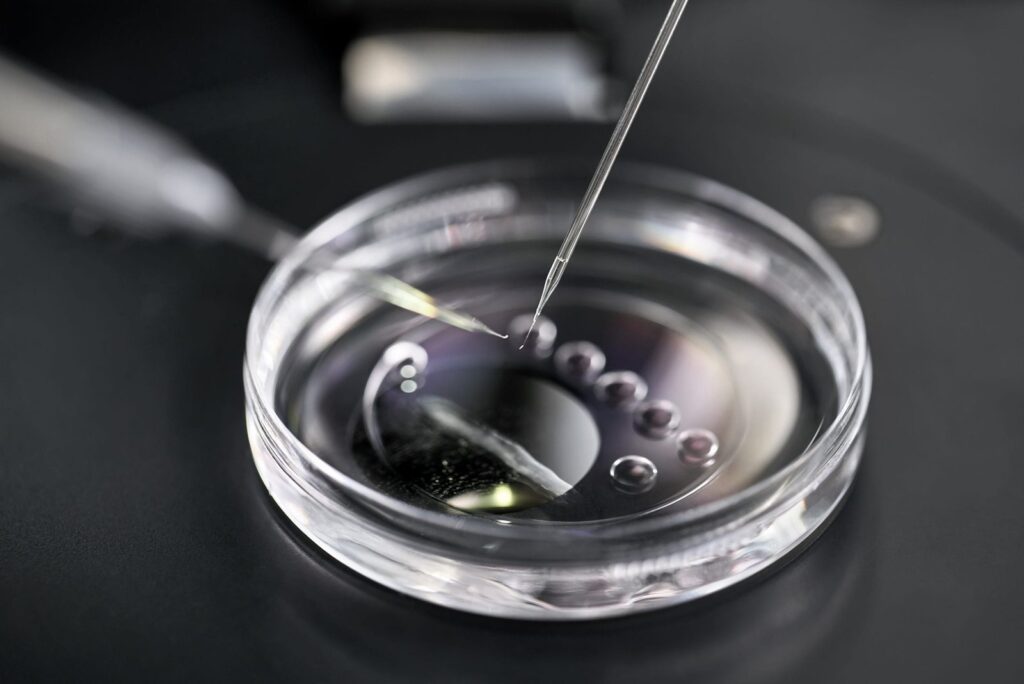
Nuclear transfer (NT) is a new approach to infertility treatment, which consists in transferring the patient’s nuclear material into the cytoplasm of a donor egg. The logic behind this method is that certain negative factors may be related to the oocyte cytoplasm and can be overcome by replacing the cytoplasm.
Internal embryonic factors that lead to embryonic arrest:
- Features of gene expression
- Disorders of mitochondrial DNA quantity and function
- Features of methylation
- Small non-coding RNAs
- Chromosomal abnormalities
- Metabolic profile of the embryo
- Specific morphological characteristics, in particular vacuolization
The role of mitochondria in oocytes
Oocytes have the largest number of mitochondria and copies of mitochondrial DNA (mtDNA) compared to other cells in the body. Mitochondria in oocytes have two main roles: supporting the metabolic needs of the oocyte and regulating apoptosis, while also serving as a reservoir of intact mtDNA for the future development of offspring. During follicle recruitment, the mitochondrial mass can increase from 6000 copies of mtDNA to 200000, making them more vulnerable to mutations and deletions.
Methods of nuclear transfer
There are several nuclear transfer methods that are used both before and after fertilization:
- Before fertilization: Germinal vesicle transfer (GVT), Chromosome division spindle transfer (MIST | MIIST), First polar body transfer (PB1GT)
- After fertilization: Transfer of the second polar body (PB2GT), Pronuclear transfer (PNT)
Experience of the IVMED clinic
Among patients who underwent fission spindle and polar body transfer (MS and PB1), the average age of patients is 40.3 years, and the average number of previous IVF-ICSI attempts is 3.3. We used 99 M II oocytes from patients and 166 M II oocytes from donors. Successful reconstruction was achieved in 86% of cases, with a fragmentation rate of 60% and a blastocyst formation rate of 29%.
Patients who underwent pronuclear transfer (PNT) had a mean age of 39.7 years, and the mean number of previous ICSI attempts was 3.8. We used 185 M II oocytes from patients and 277 M II oocytes from donors. Successful reconstruction was achieved in 83.4% of cases, the rate of stem fragmentation was 72.2%, and the rate of blastocyst formation was 44%.
Conclusions
Oocyte reconstruction in certain cases can be considered as an alternative to oocyte donation. The choice of a specific technique depends on the number and quality of oocytes, as well as the clinical situation. Mitochondrial diseases are not always an indication for nuclear transfer if there is no technology to completely remove maternal mtDNA. NPs are less effective for older women. Each case is unique and requires an individual approach. The use of NPs allows you to get pregnant in cases where standard IVF does not work.
Today we have live births after such treatment, which is our joint achievement with our patients!